Beyond the Chat Box: Twelve posts in, here's what we've learned

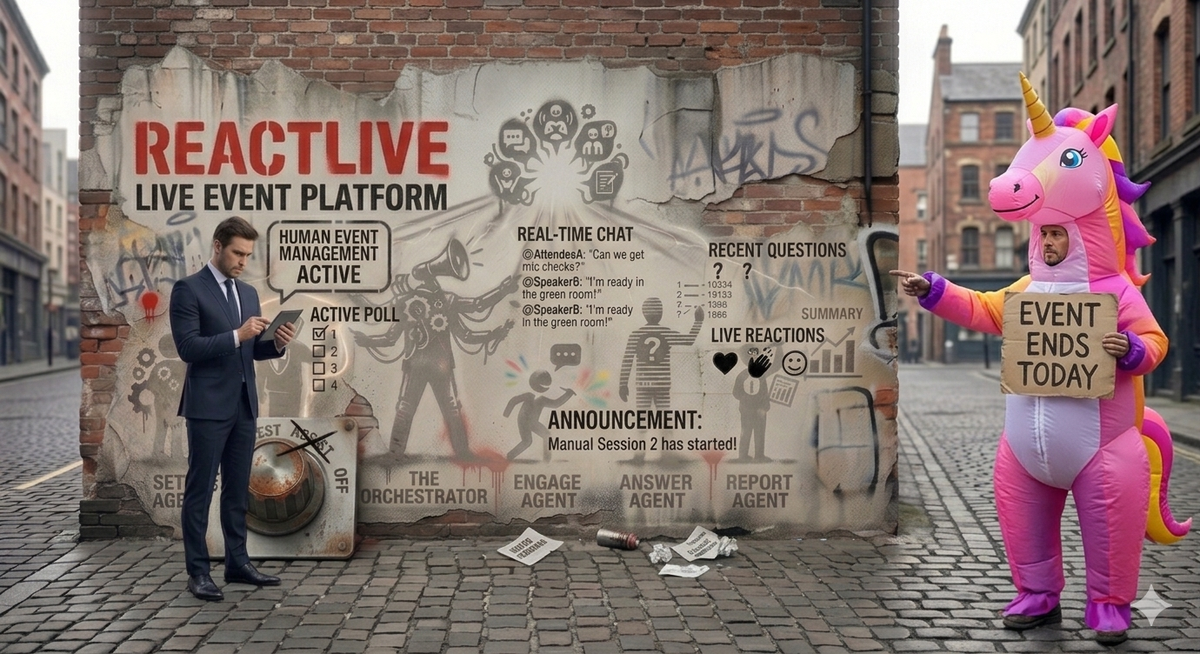
Post twelve of a series on what live audience engagement actually looks like when there's an AI team in the room. The finale.
When we started writing this series, we set ourselves a constraint.
Don't write the marketing version. Don't claim things the architecture doesn't actually do. Don't promise outcomes we haven't seen. If a post needs a number to be credible, only put a number in if we have one. Otherwise, leave the post qualitative and let the architecture carry the argument.
That constraint shaped a lot of what's in the previous eleven posts — and a lot of what isn't.
This finale is about what we've actually learned. Not from running ten thousand events ourselves — we haven't. Not from publishing a glowing case study from a launch customer — we don't have one yet. The series went out before the volume of evidence did, deliberately, because the architecture is the argument and the architecture exists now.
What we have learned is what the conversations with prospective customers have taught us. Hundreds of them, over the months we've been building. People telling us about the events they run, the moments those events fail, the workarounds they've built, the things they wish their current platform did, and the things they're nervous about an AI doing in front of their audience.
This post is the patterns from those conversations.
The conversation we have most often
Almost every prospective customer conversation starts in the same place.
"We do town halls on Slido. They're fine. We get a lot of questions, we answer maybe a tenth of them, and the rest die in the export. Honestly the worst part is the week after — we keep saying we'll follow up on the unanswered ones and we never do."
This is the opening pattern the entire series is built around — a chat-box feed that collects more than it resolves, and an organisation that's slowly accepted that as the cost of having town halls at all. We've heard a version of this conversation from comms leads, IR teams, internal communications managers, founders, podcasters, conference producers, and university administrators. The names of the products change. The shape of the problem doesn't.
What's changed in the last six months is what people expect to be possible. Two years ago, the conversation ended with a shrug — "that's just how it is." Now it ends with "could AI fix that?" Hosts know the technology has moved. They're looking for somewhere it can move them.
That's the change the series is responding to. Not that audience engagement just got broken — it's been broken for a decade. That hosts have stopped accepting that it has to stay broken.
What hosts ask for first, and what they actually need
There's a gap we see in almost every conversation between what hosts ask for and what their events actually need.
What they ask for is usually some version of "can the AI answer questions for us?" — the most legible feature of an AI-native engagement platform, the one that maps cleanly to the AI products they've used in other contexts.
What they actually need, once we walk through their event, is almost never just answers. It's:
- A moderator who isn't drowning
- Anonymous Q&A that's safe to enable
- Setup that doesn't take two hours
- A recap that arrives before the next meeting
- Confidence that nothing inappropriate appears in front of the audience
- Patterns across events that surface themes the host couldn't see in real time
The Answer Agent is the headline. The other four agents are why hosts actually buy. We didn't fully understand this until we'd had thirty or forty of these conversations — and it's why the Setup Agent post, the Protect Agent post, the Engage Agent post, and the Report Agent post all have the structural argument they do. Each of these solves a problem that's bigger than it looks, and that's invisible until you walk through someone's actual event.
The series exists in the order it does for this reason. If we'd written only the Answer Agent post, we'd have answered the question hosts ask. We wouldn't have answered the questions their events are actually asking.
What we've consistently been wrong about
A few things we believed at the start of the series that the conversations have changed.
We thought hosts would worry most about hallucination. They don't, mostly. They worry about the AI sounding wrong — wrong tone, wrong vocabulary, wrong register. A factually correct answer in the wrong voice is, to a comms lead, almost as bad as a wrong answer. Hallucination turned out to be a developer's framing of the risk; sounding off-brand is the buyer's framing of the same risk. The SOUL.md post became the load-bearing argument for the buyer audience because of this — the file isn't really about behaviour, it's about voice, and voice is where the trust gap lives.
We thought the dial would be received as a feature. It's been received as a thesis. "You can dial each agent independently, off through auto" turns out to be a sentence that meaningfully changes how prospective buyers think about deploying AI at all — not just in events. It maps to how they want to deploy AI in customer service, in marketing review workflows, in legal triage. The four-level dial is a primitive that travels well outside the events context, and several of the conversations have ended with prospects asking whether they could licence the framework itself.
We did not expect that. We're not pursuing it. But it's been a consistent enough pattern to mention.
We thought the off-state was a defensive concession. It isn't. It's the floor that makes everything else trustworthy. Larger organisations specifically — the ones running formal procurement processes — care about the off-state more than the auto-state, because IT and legal need to approve a platform separately from approving AI usage. The post about turning the agents off did more to unblock enterprise conversations than any of the agent-specific posts. We'd written it expecting it would feel like a small acknowledgment; it's turned out to be one of the most useful posts in the series for actually closing deals.
What we've consistently been right about
The list is shorter, but worth being explicit.
Specialisation gives hosts control. Every conversation that involves splitting moderation autonomy from answer autonomy ends with the host visibly relaxing. The "Auto on Protect, Suggest on Answer" configuration we keep coming back to in this series is exactly the configuration that makes regulated and high-stakes events feel possible.
SOUL.md is a primitive, not a feature. We've yet to have a conversation where a comms or legal stakeholder reads an example SOUL.md and doesn't immediately understand why it matters. The plain-text, version-controlled, human-readable framing is doing exactly the work we hoped it would do.
The Auto-Answer Loop is the heart of the product. Not the most-named feature in conversations, but the one that, when explained, makes the rest of the architecture click. The pattern: a host starts the conversation focused on the Answer Agent, listens to the Auto-Answer Loop explanation, and reframes the rest of their thinking around the loop rather than around individual features. The loop is the unit of value; the agents are how it gets closed.
What we don't yet know
The honest list, because the series doesn't earn its credibility without one.
We don't know how the agents perform on a multi-thousand-person event yet. We've designed for it. The architecture should hold. The grounding rules, the confidence thresholds, the moderation pipeline, the live transcription — all of it is built to run at that scale. But until a customer runs an event of that size on the production product, the architecture is an argument, not a measurement. Early access cohort first.
We don't know which use cases will lead. The seven we've designed for — Town Hall, AMA Page, Podcaster AMA, Weekly AMA, Liveblog, Watch Party, Build Your Own Page — were chosen from the conversations we'd had through early waitlist. We're confident in all seven. We don't yet know which will pull hardest, which will break first under real volume, or which will surface a use case we hadn't imagined. The platform is built to bend toward whichever ones land.
We don't know what the right pricing pressure points are. The credit-based pricing model we've launched with is informed by the cost structure of running the agents and by what comparable platforms charge — but the actual elasticity, the upgrade triggers, the events-per-tier ratios — those will become clear with real customers, not before.
There are more unknowns. We're listing the ones that matter most to a buyer who's evaluating whether to be an early customer. The honest answer to "what don't you know yet?" should appear in the finale of a series like this, or the series isn't honest.
What this series is, and isn't
The series is the architectural argument for ReactLive. Twelve posts of here's how the product is built and why those choices were made. It's deliberately ahead of the evidence — the architecture exists now, the proof of how it performs at scale comes later, and we'd rather publish the argument early and let it stand on its own merits than wait until we have a customer logo to put behind every claim.
The series isn't a case study. It isn't a benchmark. It isn't a comparison against named competitors. We've avoided naming them throughout, partly out of respect, mostly because the comparison isn't the argument we're making. Slido is fine. We are not trying to be a better Slido. We are trying to be a different category of thing — an AI-native platform, built around a closed loop between question and answer, on top of a complete events platform that works without the AI when you want it to. That's a different argument than "Slido but with AI bolted on," and it deserved twelve posts to make properly rather than a comparison table.
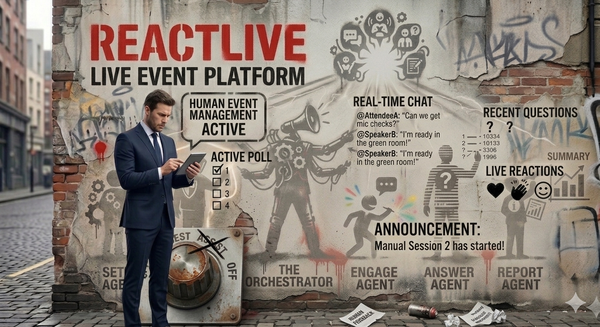
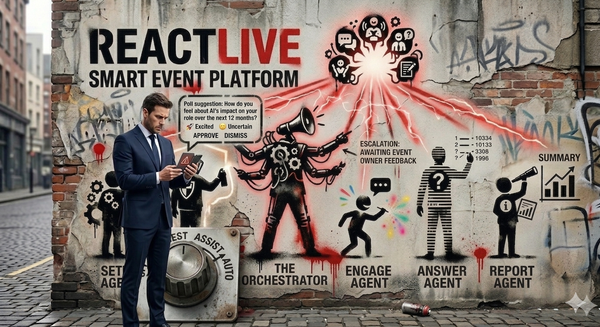
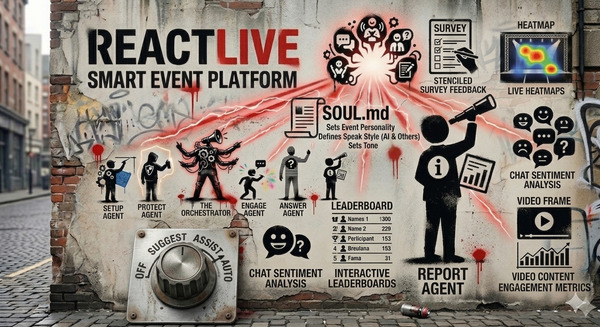
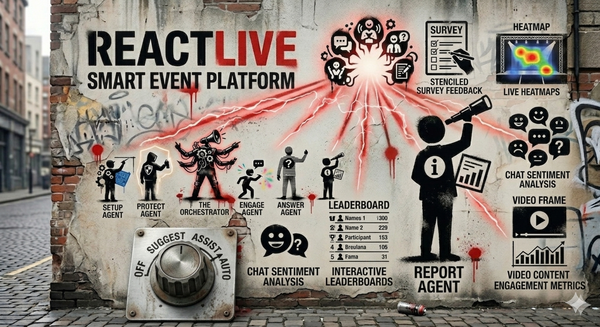
If you've read all twelve, you have the architectural model. Setup, Protect, Engage, Answer, Report. One Orchestrator. Four strength levels. One SOUL.md. The dial that makes the autonomy graduated and reversible. The off-state that makes the whole thing trustworthy.
The model isn't theoretical. It exists. It's running. And we're at the moment in any product's life where the question becomes who's willing to run their event on it first.
If that's you, the waitlist is below.
Beyond the chat box
We started this series with a thesis: that the chat box did its job, that audience engagement is the loop between question and answer, and that closing that loop requires an architecture, not a feature.
Twelve posts later, we're more convinced of it than we were when we started. Not because we've proven it at scale yet — we haven't, and we've been honest about that — but because every conversation we've had with a prospective customer has been a version of "yes, that's exactly the problem." The thesis has held up across every audience we've described it to: comms leads, founders, conference producers, IR teams, university administrators, podcast hosts. The shape of the problem doesn't change; the architecture answers it.
We built ReactLive to be the platform we'd want if we were running serious live events in 2026 — events where the audience deserves better than a chat-box backlog and where the host has more important things to do than triage. That platform exists now. The agents are real. The dial works. SOUL.md is a file you can write today.
The chat box did its job. It's time to go beyond it.
Don't fix the chat box. Replace what surrounds it.
That's beyond the chat box. That's where engagement actually lives.
This is the final post in the series. Thanks for reading.
The whole series in one place:
- 1. Why a Q&A feed isn't engagement
- 2. Five agents are better than one big AI
- 3. Off, Suggest, Assist, Auto — the dial that makes AI moderators trustworthy
- 4. The Setup Agent — from "two hours of config" to "paste your agenda"
- 5. The Protect Agent — moderation that doesn't make you choose between safety and speed
- 6. The Engage Agent — nobody should have to read 400 questions live
- 7. The Answer Agent — grounded answers, or no answer at all
- 8. The Report Agent — the debrief nobody has time to write
- 9. SOUL.md — one file for tone, voice, rules, and red lines
- 10. The Orchestrator doesn't outrank your moderator
- 11. What happens when you turn all the agents off
- 12. Twelve posts in, here's what we've learned (this post)
Join the waitlist to get early access. Three free events. Locked-in pricing.