Beyond the Chat Box: The Engage Agent — nobody should have to read 400 questions live

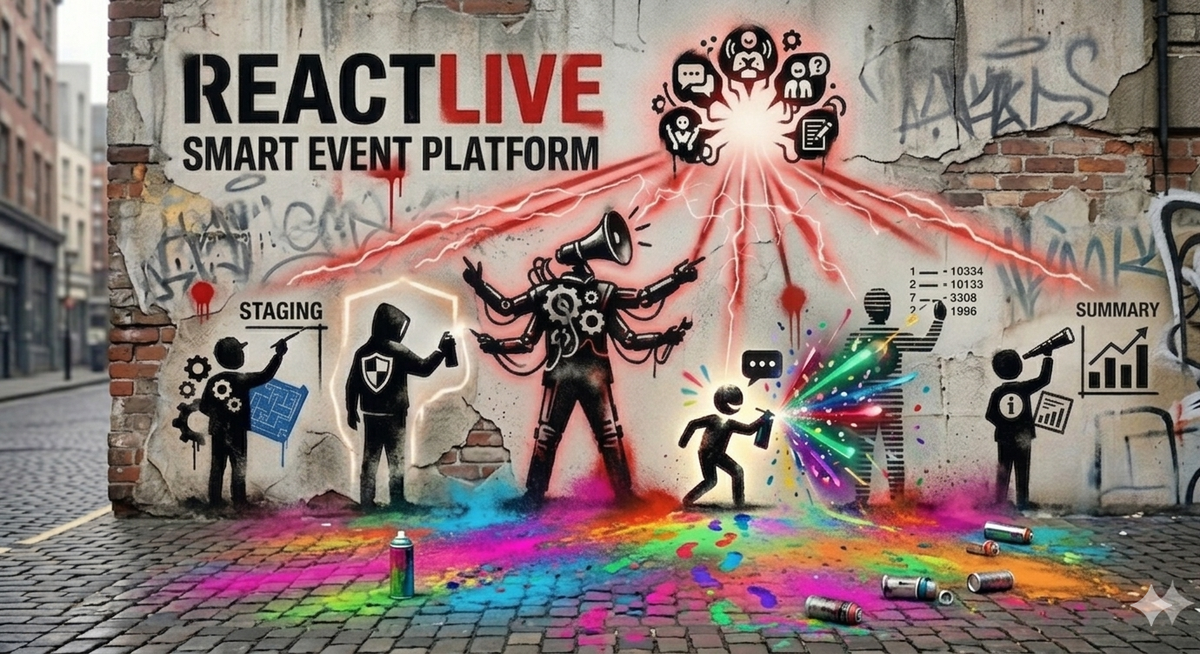
Post six of a series on what live audience engagement actually looks like when there's an AI team in the room.
Watch a moderator work a 400-person live event sometime.
They're sitting in front of two screens. One is the live stream — they need to know what the speaker is saying so they can route relevant questions and avoid surfacing one that just got answered. The other is the Q&A panel, scrolling faster than they can read. Slack is open in a third window, where the host's chief of staff is pinging them with "can we get a question about hiring next?" The moderator is also clustering duplicates in their head, watching for the moment the room's mood shifts, deciding when to drop a poll, and trying to remember which submitter asked something brilliant ten minutes ago because the speaker just circled back to that topic.
This is one human, doing six jobs, in real time, with no pause button.
It's an impossible task, and it's been the unspoken cost of "having a moderator" at every live event for fifteen years. The reason most events don't engage their audience well isn't that the moderator is bad at their job — it's that the job is structurally undoable at scale.
The Engage Agent is built to give the moderator their attention back.
Six jobs, one human
Let's name what the moderator is actually doing.
Reading. Every submission. As they come in. Faster than the audience can read them.
Clustering. Recognising that questions 12, 47, and 103 are the same question phrased differently — and that the answer to one of them resolves all three.
Ranking. Deciding which question is the best next one for the host to take live, given what's just been said, who's submitted it, and what the room seems to want.
Sensing the room. Watching engagement signals — submission rate, reaction velocity, drop-offs — to know when the audience is locked in and when they're losing interest.
Detecting topic shifts. Noticing the moment the speaker has moved on from a topic so the moderator stops surfacing questions about the previous one.
Triggering content. Knowing when to drop a poll, push a CTA, surface a highlight, or spotlight a great question — and when to let the moment breathe.
These are six different kinds of cognitive work, and the moderator is doing all of them simultaneously. The reading is the obvious bottleneck — at 400 submissions across a 60-minute event, that's nearly seven submissions per minute, and many of them are paragraphs. Reading alone consumes the moderator's full attention, leaving nothing for the other five jobs.
So the other five don't get done well. Clusters get missed. Priority stays in random mode. The room's mood goes unread. Topic shifts arrive late. Polls drop at the wrong moment, or don't drop at all.
This isn't a moderator failure. It's a category failure — we've been asking one human to do work that fundamentally requires either a team or a machine.
The Engage Agent is the machine version of that team.
What the Engage Agent does
The Engage Agent runs continuously through the live event. Six core skills, mapped one-to-one against the six jobs above.
Priority ranking. The agent reads every submission as it arrives and assigns a relevance score against the current state of the event — what the speaker just said, what's still unanswered, what the audience is most upvoting, what's distinct from what's already been covered. The moderator's queue is sorted by what should be answered next, not by what arrived most recently. The brilliant question buried at position 47 surfaces; the duplicate at position 12 doesn't.
Clustering. Similar submissions are grouped automatically. A question asked five different ways becomes one entry in the queue, with the variants attached. The moderator answers it once, and the system marks all five variants as resolved. The submitters all feel heard, the host doesn't repeat themselves, and the queue gets shorter without anything being dropped.
Moment detection. The agent watches for two specific signals: topic shifts and engagement drops. Topic shifts trigger automatic deprioritisation of questions about the previous topic — they're not deleted, just demoted, because once the speaker has moved on, surfacing a question about the old topic feels jarring. Engagement drops trigger an alert: submission rate has fallen, reactions have slowed, the audience is checking out. The moderator gets a heads-up before the energy is gone.
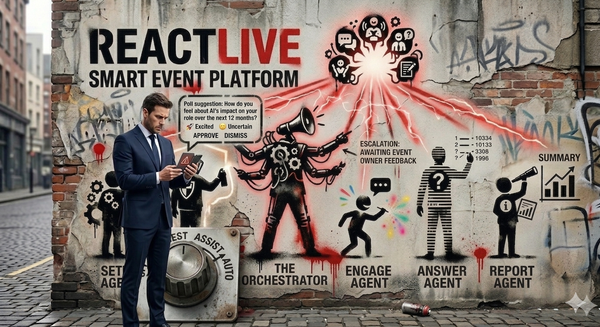
Content triggering. Polls, prompts, highlights, announcements — the agent can suggest or auto-publish them at the right moments. A topic shift is often a good moment for a quick pulse poll on the topic just covered. A great question that the host answered well is a good moment to highlight the exchange for the audience. The agent knows the templates and reads the timing.
Audience sensing. Beyond submission rate and reactions, the agent reads sentiment patterns in the submissions themselves — whether the room is engaged, sceptical, confused, or restless. This isn't a number on a dashboard; it's a contextual read that informs the agent's other decisions.
Timing optimisation. The most important skill, and the one most often missed by event tools that have polls or prompts but not the judgment about when to drop them. The agent doesn't interrupt key moments. When the speaker is mid-answer, mid-story, or mid-emotional-beat, the agent stays quiet. When there's a natural pause, a topic transition, or a clear signal that the audience needs a new touchpoint, the agent acts.
The output: a moderator who is doing one job — exercising judgment on the calls only humans should make — while the agent does the other five.
What the moderator does instead
This is the part that matters most.
People sometimes assume that an Engage Agent replaces the moderator. It doesn't. It changes what the moderator does.
Without the agent, the moderator is doing reading, clustering, ranking, sensing, detecting, and triggering — six jobs, all reactive, none of which are uniquely human. Any of those jobs done at machine speed would be a strict upgrade over the current state.
With the agent, the moderator does what only a human moderator can do:
Reading the human room, not the dashboard. The agent can read sentiment in the text. It can't read the look on the speaker's face. The moderator can. When the speaker is visibly uncomfortable with a topic, the moderator decides whether to give them a softer landing or push the room toward the harder follow-up. That's a judgment call about a person, not about data.
Catching what the agent shouldn't surface. Some questions are technically high-priority but politically wrong for this moment. Some are good questions from the wrong submitter for the wrong audience at the wrong time. The moderator knows the org. The agent doesn't. When the agent ranks a question highly that the moderator knows would land badly, the moderator overrides — and the agent learns from that for future events.
Picking the moments that need a real voice. The best moments in live events are the ones where someone with authority or empathy or wit takes a question and elevates it into something the audience didn't expect. That's not an agent decision. The agent's job is to surface the question that could become that moment. Whether it actually does is on the human in front of the audience — and on the moderator's judgment about which questions to put in front of them.
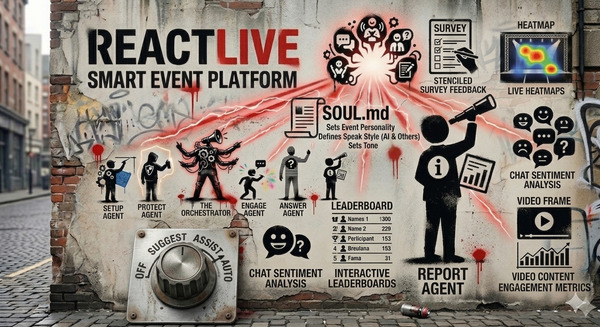
Calibrating the agent in flight. The moderator can dial the agent up or down during the event. Engage on Suggest if the room is tense and every prompt feels too aggressive. Engage on Auto if the room is humming and every poll the agent has dropped has landed well. The dial isn't set once and forgotten — it's a live instrument the moderator plays.
The Engage Agent doesn't make the moderator obsolete. It makes the moderator good at their job in a way that wasn't physically possible before.
The dial, applied to engagement
Worth walking through the four levels specifically for Engage, because the cost-benefit shifts in interesting ways compared to Protect.
Off. No AI-driven engagement. Submissions arrive in chronological order; the moderator reads, clusters, and ranks manually. Polls are pre-scheduled or triggered by hand. This is the right setting for small, intimate events where a human moderator can comfortably handle the load — under maybe 50 submissions across the event.
Suggest. The agent recommends. Polls, prompts, questions to highlight. The moderator approves each one. This is the right setting for first-time hosts and politically sensitive events — every published action has a human in the loop.
Assist. The agent auto-publishes low-risk engagement (a routine pulse poll, a clearly safe question highlight) and asks for approval on key moments (a poll on a sensitive topic, a highlight that names a specific employee). The moderator's approval queue is much shorter and more meaningful — only the calls that actually need judgment land in it.
Auto. The agent drives engagement in real time. It surfaces questions, runs polls, manages flow, and adjusts to the room's energy without waiting for permission. The moderator can override anything but doesn't have to be steering the engagement — they're free to focus on the human-only work above. This is the setting for events where the host has run this configuration enough times to trust the agent's calibration with the room.
A note worth surfacing: Auto on Engage isn't louder, it's better-timed. The frequency of polls and prompts isn't determined by the level of autonomy — it's determined by the configuration. A reserved configuration on Auto produces a quiet, well-paced event with a few well-timed touch points. An aggressive configuration on Suggest produces a busy event whose every interruption was approved by the moderator. The dial controls who acts, not how often things happen.
What the Engage Agent does not do
It doesn't interrupt key moments. This is the hard rule, written into the agent's behaviour. Speaker mid-thought, audience locked in, emotional moment unfolding — the agent doesn't drop a poll across that. The agent's job is to act when the room can absorb action, not to follow a schedule.
It doesn't drown the audience in interaction. More polls and prompts is not a goal. The agent is tuned to add touch points when they earn their place — not to maximise interaction count for its own sake. An event with three perfectly-timed polls is a better-engaged event than one with twelve forgettable ones.
It doesn't choose questions for political reasons. The agent's ranking is based on relevance, distinctness, and audience signal — not on which question is easiest for the host to answer. A hard question that the audience clearly wants surfaced will get ranked accordingly, even if the host would prefer it didn't. Whether that question gets put to the speaker is the moderator's call, not the agent's.
It doesn't pretend to know what only a human can know. When the agent's confidence in a ranking, a cluster, or a moment-detection is low, it surfaces the uncertainty rather than guessing. The moderator can act on a confident agent suggestion fast and on a low-confidence one with appropriate care.
The bigger shift
There's a version of this post that would be about the Engage Agent's features. This isn't quite that post.
The bigger shift is what happens when one of the moderator's six jobs — the reading, the routine clustering, the obvious ranking, the timing of the safe stuff — gets done at machine speed. Not "the moderator becomes redundant." The opposite: the moderator finally has time to do the parts of the job that needed them all along.
That's the unlock. Not AI replacing the human in the room. AI giving the human in the room enough breathing space to actually be present in it.
Next up: The Answer Agent — grounded answers, or no answer at all. The agent that closes the loop between question and answer, the three-state confidence model that keeps it honest, and why "no answer" is sometimes the right answer.
Join the waitlist to get early access. Three free events. Locked-in pricing.