Beyond the Chat Box: Off, Suggest, Assist, Auto — the dial that makes AI moderators trustworthy

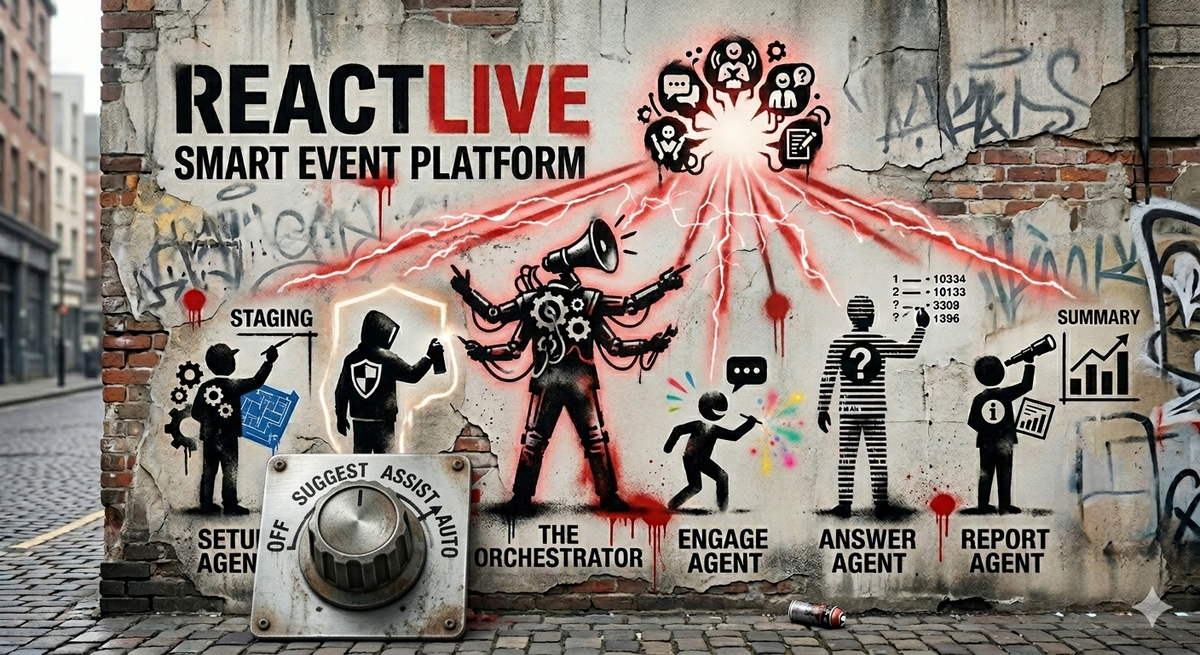
Post three of a series on what live audience engagement actually looks like when there's an AI team in the room.
The single most common reason event hosts don't use AI in production isn't capability.
It's framing.
Most AI products give you one switch. On or off. Trust the model or don't. Run the chatbot or unplug it. There's no middle ground — and live events, of all things, are not the place to be flipping a binary switch on something that talks to your audience.
So hosts do the rational thing. They leave it off. The AI demo was impressive in the sales call. They never use it on a real event.
That's the trust problem. And it's a packaging problem, not a technology problem.
ReactLive solves it with a dial.
Four levels, per agent, per event
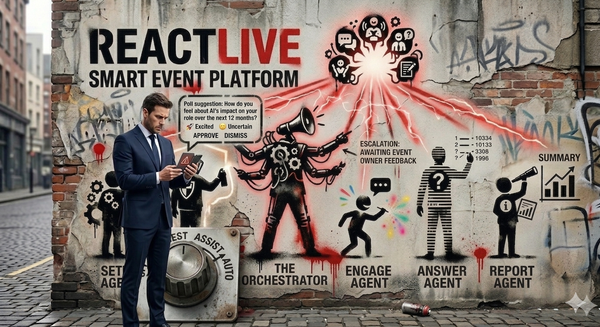
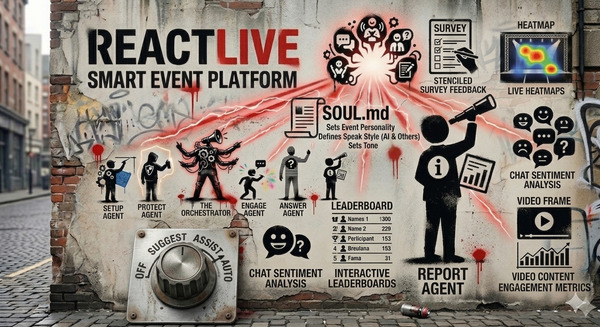
Every agent in ReactLive — Protect, Engage, Answer — has four strength levels:
- Off — the agent does nothing. ReactLive falls back to clean human moderation.
- Suggest — the agent recommends. The moderator decides.
- Assist — the agent acts on safe, high-confidence cases. The harder calls go to the moderator.
- Auto — the agent acts autonomously, within the rules you've set.
You set the dial per agent, per event. Not per platform. Not per tenant. Per event. Your Tuesday town hall and your Thursday product launch can run completely different configurations.
That's the headline. Now the why.
Why a dial beats a switch
Three things change when you replace on/off with a four-position dial.
You can adopt the platform without trusting the AI yet. This is the underrated one. New users can run their first event with every agent set to Off and ReactLive becomes a clean, fast Q&A and polls platform with a live transcript. They get value on day one. Then, on event two, they flip Protect to Suggest just to see what it would have caught. On event five, Protect goes to Assist. On event ten, Auto. The platform earns trust at the user's pace, not at the vendor's.
You can match the dial to the stakes. A weekly internal AMA with thirty engineers and a regulated all-hands with four thousand employees aren't the same event, and they shouldn't run the same configuration. The AMA can run Engage on Auto — the cost of an over-eager poll is nothing. The all-hands needs Engage on Suggest because every prompt to the room has political weight. Same agents. Same product. Different dial. Different event.
You can dial agents independently. This is the architectural payoff from the five-agents post. Want autonomous moderation but human-reviewed answers? Set Protect to Auto and Answer to Suggest. Want the inverse — light-touch moderation but aggressive auto-answering of FAQ-style questions? Flip them. One model with one prompt cannot do this without the long, brittle conditional prompts we talked about last time. Five agents with five dials can do it in ten seconds.
Walking the dial: a host's first three events
The clearest way to show what this actually feels like is to walk through how a typical host adopts ReactLive over their first three events.
Event one: everything on Suggest.
The host runs the event with all three live agents in recommend-only mode. The agents do their work in the background — flagging risky submissions, clustering duplicates, drafting answers — but nothing goes live without the moderator clicking through it. The moderator's job feels harder than usual at first, because they're seeing more than they used to. By the end, they've reviewed about 80 AI suggestions. They notice that the Protect Agent is right about spam roughly every time. They notice the Answer Agent's suggestions are accurate but wordy. They notice the Engage Agent surfaced a great question they would have missed.
The post-event debrief writes itself: Protect is ready for more. Answer needs tone adjustment. Engage is doing real work.
Event two: Protect on Assist, others stay on Suggest.
The host moves Protect to Assist. Now obvious spam is auto-blocked — the moderator never sees it. Edge cases still come for review. The moderator's queue gets noticeably lighter. They spend the time saved on the Answer Agent's suggestions, editing tone in the SOUL.md so future drafts sound more like the host. By the end of event two, Protect has handled most of the noise without intervention. The moderator confirms: nothing got blocked that shouldn't have.
Event three: Protect on Auto, Answer on Assist, Engage on Assist.
The host has earned enough confidence to let Protect run autonomously. They also move Answer to Assist — the agent now publishes answers automatically when its confidence is high enough and the source is solid, escalating the rest. Engage moves to Assist too, auto-publishing low-stakes prompts and asking before key moments.
By event three, the moderator is doing the part of the job only a human can do: reading the room, watching for the moment that needs a real human voice, escalating the things the AI shouldn't touch.
This is the trajectory the dial enables. Hosts don't go from zero to autonomous in one step. They climb. Three events in, they're running with significantly more AI assistance than most products would have made them commit to on day one — and they've earned every click of the dial.
What changes at each level
It's worth being concrete about what each level actually does, because the names are abstract until you see them in action.
Off. Disabled. The agent isn't running. Submissions arrive in the moderator queue exactly as they did before AI existed. ReactLive without agents is still a fully functional events platform — the live transcript, the Q&A, the polls, the reactions all work fine. This is the level for events where you can't or don't want any AI involvement, and for users still building trust in the system.
Suggest. The agent runs its full pipeline, but takes no action. Everything it would have done — block this, flag that, surface this question, draft this answer — appears as a recommendation in the moderator's interface. The human approves, edits, or rejects. Suggest is the right setting for a host's first event, for politically sensitive moments, and for anything where you're still calibrating how the agent behaves on your content.
Assist. The agent acts autonomously on high-confidence, low-risk cases. Obvious spam gets blocked without review. Clearly safe engagement prompts get published. Frequently-asked questions whose answers are unambiguous in your uploaded sources get answered. Anything ambiguous gets escalated to the moderator. Assist is the workhorse setting — it removes the bulk of grunt work without putting judgment calls into autopilot.
Auto. The agent acts autonomously, full stop, within the rules you've set in SOUL.md and the policies you've configured. It still escalates anything outside its remit. It still defers to human override at any time. But it doesn't wait for approval to act on the things it's allowed to act on. Auto is the setting for events the host has run many times before with this configuration, where the team trusts the agent's judgment to handle the live event in real time.
The crucial detail: at every level, the human moderator can override anything, any time. Auto isn't unsupervised. Auto means the agent doesn't pause to ask permission. The override pathway is always live.
What the dial says about how AI should ship
There's a broader argument hiding inside this post, and it's worth surfacing.
Most AI products are shipped at a single, fixed level of autonomy. The vendor decides how aggressive the AI should be, ships that, and you take it or leave it. Sometimes the vendor offers a couple of feature toggles. Almost never do they offer real autonomy graduation.
That's a mistake. Trust isn't a property of the model — it's a property of the relationship between the model and the user. The same agent, with the same accuracy, will be welcomed at one level of autonomy and rejected at another. Capability isn't the bottleneck. Calibration is.
The dial is our answer to that. It's not a feature. It's a thesis about how AI should reach production: earned, per-task, per-context, with the human always in charge of the speed of adoption.
The five agents tell you what ReactLive does. The dial tells you how it ships.
Next up: The Setup Agent — from "two hours of config" to "paste your agenda." How the first agent in the chain turns event preparation from the worst part of the host's week into the easiest.
Join the waitlist to get early access. Three free events. Locked-in pricing.